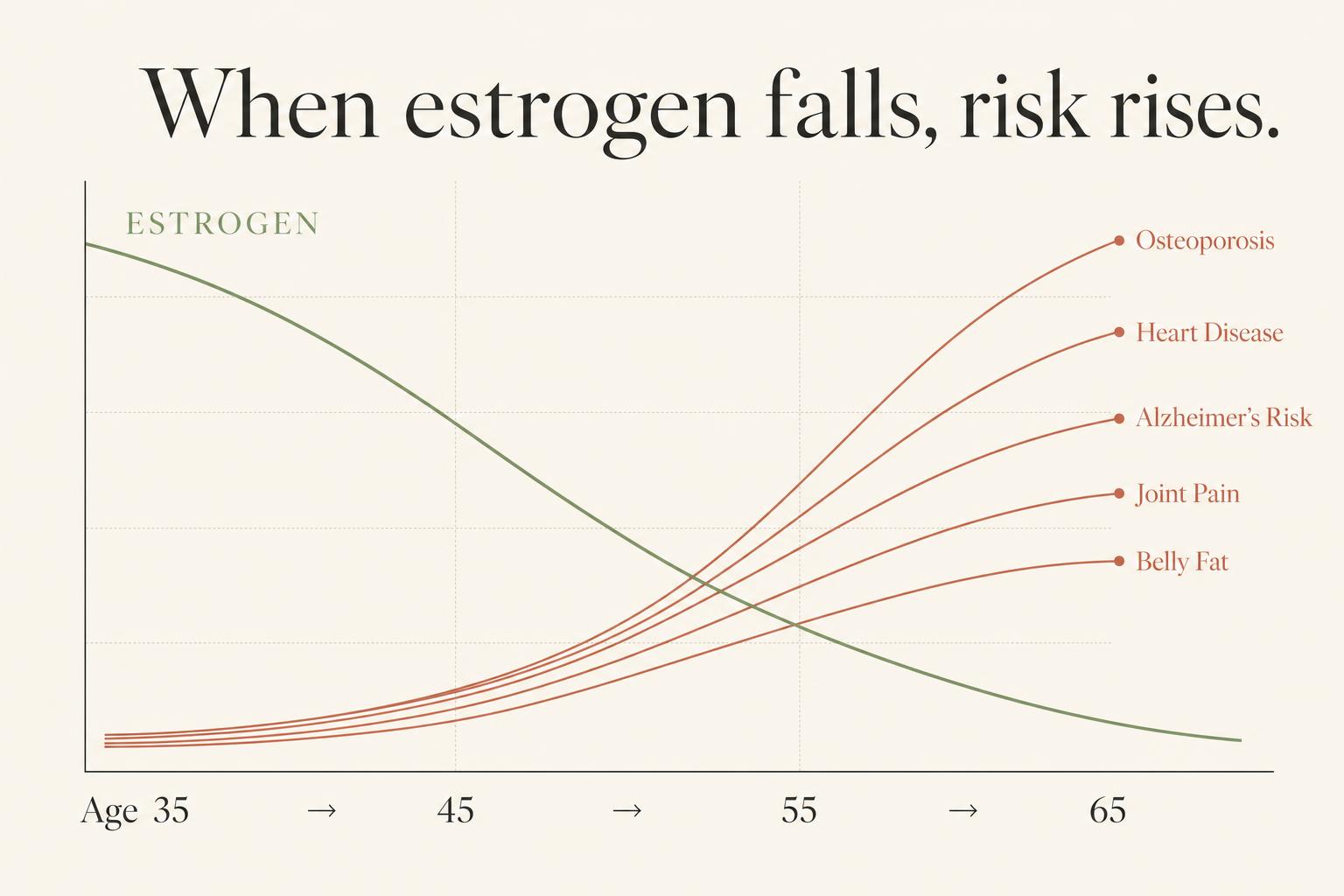
Hot flashes get the headlines. Night sweats, mood swings, the sudden urge to throw the duvet across the room at 3 a.m. — these are the symptoms women are warned about, joke about, and eventually tolerate. But menopause is so much bigger than that. The flashes fade. What happens quietly underneath, over the next 10, 20, 30 years, is the part of the conversation almost no one is having with you.
Menopause is a longevity event
Estrogen, progesterone, and testosterone aren't just reproductive hormones. They are systemic signaling molecules that protect bone, blood vessels, brain tissue, muscle, collagen, and metabolism. When they decline — and stay declined for the rest of your life — the risk curves for some of the most serious diseases of aging start to climb.
- Heart disease becomes the #1 killer of women after menopause.
- Osteoporosis affects 1 in 2 women over 50 — and a hip fracture in your 70s carries a higher one-year mortality than many cancers.
- Dementia and Alzheimer's disproportionately affect women, and the shift begins in perimenopause.
- Sarcopenia — the silent loss of muscle — accelerates, driving falls, frailty, and metabolic decline.
Menopause isn't a switch that flips and ends. It's the start of a hormonal landscape your body will live in for a third of your life. How you support it now shapes how you age.
Your bones: the silent emergency
Women can lose up to 20% of their bone density in the 5–7 years around menopause. Estrogen normally restrains the cells that break bone down (osteoclasts) and supports the cells that build it (osteoblasts). When estrogen drops, the breakdown side wins — quietly, painlessly — until a wrist, vertebra, or hip fractures from something ordinary.
Most women find out their bones are fragile after the first fracture. By then, the next one is much more likely. The window to actually prevent osteoporosis is in perimenopause and the first decade after the last period — exactly when most women are told their labs are "normal" and to come back if anything gets worse.
Your heart, brain, and metabolism
- Cardiovascular. Estrogen keeps blood vessels flexible and supports healthy cholesterol patterns. After menopause, LDL and Lp(a) often climb, blood pressure rises, and arterial stiffness accelerates.
- Brain. Estrogen fuels glucose metabolism in the brain. As it falls, many women experience the now well-documented "brain fog," word-finding lapses, and sleep disruption — and the same biology underlies long-term cognitive risk.
- Metabolic. Body composition shifts toward visceral fat. Insulin sensitivity drops. Muscle is harder to build and easier to lose. The same calories and workouts that worked at 35 stop working at 50 — not because you're failing, but because the hormonal signaling has changed.
What actually protects you
A modern, longevity-focused approach to menopause goes far beyond "treat the hot flashes." At Healing Art Centers, we build a plan around the next 30 years, not the next 30 days.
- Bioidentical hormone therapy (BHRT). When started in the right window and individualized, restoring estrogen, progesterone, and testosterone has been shown to support bone density, cardiovascular health, brain function, sleep, mood, libido, and body composition. We use hormones that are molecularly identical to your own — not synthetic substitutes.
- Bone-protective testing & therapy. DEXA scans, bone turnover markers, vitamin D, and calcium balance — paired with hormones, resistance training, and targeted nutrients (vitamin K2, magnesium, collagen, protein at every meal).
- Strength is medicine. Resistance training 2–4x per week is one of the single most powerful longevity interventions for menopausal women. Muscle is the organ of longevity — and the bank account that protects your bones, blood sugar, and independence.
- Metabolic & cardiovascular labs. Fasting insulin, A1c, advanced lipid panel including ApoB and Lp(a), hs-CRP, homocysteine — the numbers that actually predict the next 20 years, not just the next physical.
- Regenerative support. Red light therapy, hyperbaric oxygen, peptides, and PRF when joints, skin, or recovery need extra help — because aging well isn't just about preventing disease, it's about feeling strong in your body.
It's not too late — and it's not too early
If you're in perimenopause, this is the most important hormonal window of your adult life. If you're 5, 10, or 15 years past your last period and have been told the door is closed — it's worth a real conversation. The science on hormone timing, dose, and delivery has evolved enormously, and many women who were turned away a decade ago are excellent candidates today.
You deserve more than symptom management. You deserve a plan for the woman you want to be at 70, 80, and 90 — strong, sharp, mobile, and unmistakably yourself.
Wondering if this is what's going on with you?
Dr. Tammy can help you connect the dots between your hormones and your symptoms — and build a plan that treats the cause, not just the pain.