Signature service
Hormone Pellet Therapy
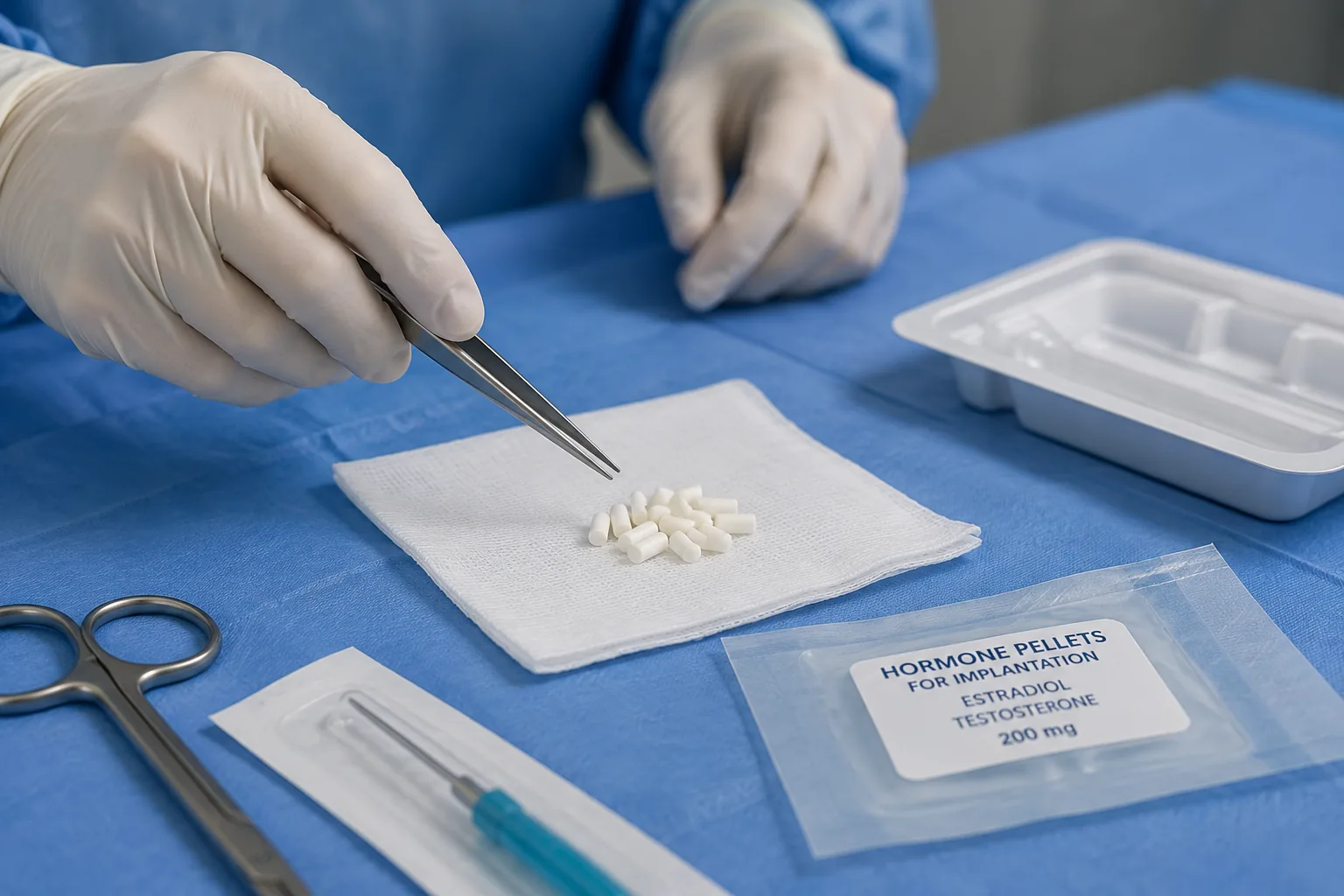
Tiny bioidentical pellets — about the size of a grain of rice — placed just under the skin to release hormones gradually over months. A steady, physiologic delivery for women and men navigating perimenopause, menopause, or low testosterone.
The basics
What is hormone pellet therapy?
Hormone pellet therapy is a form of hormone replacement where tiny pellets, about the size of a grain of rice, are placed under the skin to slowly release hormones over time. They're usually inserted in the hip or upper buttock area during a quick in-office procedure.
The goal is to support hormone levels in people struggling with symptoms of hormone decline — especially during perimenopause, menopause, or low testosterone states. Pellets are most commonly made with estrogen or testosterone, and release hormones gradually over several months.
How it works
Slow-release, like fertilizer for your hormones.
Instead of taking a pill every day or applying a cream every morning, the pellet slowly dissolves and continuously releases hormones into the bloodstream. Most patients receive insertions every 3 to 6 months depending on metabolism, symptoms, and hormone needs.
- 01
Numb the area
A small spot on the hip or upper buttock is numbed.
- 02
Tiny incision
A small incision is made — barely noticeable.
- 03
Insert the pellet
The pellet is placed just under the skin.
- 04
Bandage & go
Most patients return to normal activity quickly.
Steady delivery
Why pellets feel different than pills, patches, or injections.
Other delivery methods can spike and crash — leaving you on a hormonal rollercoaster. Pellets release hormones gradually, helping levels stay closer to a steady, physiologic range between visits.

Personalized treatment begins with your symptoms, goals, and laboratory results
Men and women are different
Pellet therapy isn't one-size-fits-all — and it isn't the same for men and women.
The hormones, the doses, the goals, and even the risks are different. Here's how we think about it for each.
For women
Perimenopause, menopause & low testosterone in women
Women can receive testosterone pellets, estradiol pellets, or both placed during the same procedure — as separate pellets, so each hormone can be dosed independently. Testosterone therapy in women is off-label in the United States, but clinically important for energy, libido, mood, and lean muscle when properly dosed.
What it can help
- • hot flashes
- • night sweats
- • brain fog
- • low libido
- • poor sleep
- • mood swings
- • fatigue
- • vaginal dryness
- • loss of muscle tone
- • weight changes
Important: A woman with a uterus who is receiving systemic estradiol still needs adequately dosed progesterone — usually oral micronized progesterone — for endometrial protection. Progesterone is not a reliable pellet option, and we do not treat a "progesterone pellet" as dependable uterine protection.
For men
Low testosterone (Low-T) & andropause
For men, pellet therapy is primarily testosterone. Doses are substantially higher than women's doses because we're restoring a male physiologic range — and we monitor with labs to avoid overshooting estradiol, hematocrit, or PSA.
What it can help
- • low energy
- • brain fog
- • low libido
- • erectile issues
- • poor sleep
- • mood / motivation
- • loss of muscle
- • weight gain
- • recovery
- • confidence
Estrogen management in men: Some compounding pharmacies can add an aromatase inhibitor (anastrozole) into a testosterone pellet to reduce conversion of testosterone to estradiol. We only consider this for a documented problem — not routinely. Crushing estradiol "just because the number rises" can hurt bone, libido, mood, joints, and cardiovascular health.
Personalized compounding
Can we compound specialty medications into a pellet?
Yes — in select cases. A compounding pharmacy can incorporate certain medications, like an estrogen blocker (anastrozole), directly into a testosterone pellet so patients don't have to take a separate daily pill. But "possible" isn't the same as "appropriate for everyone." Here's our honest clinical ranking.
What we routinely use
- Testosterone pellets — common and practical for both men and women, but easy to overdose in women. Careful dosing and labs matter.
- Estradiol pellets — used primarily for menopausal estrogen replacement, often inserted alongside a separate testosterone pellet in the same visit.
Niche / case-by-case only
- Testosterone + anastrozole pellets — reserved for a clearly documented aromatization problem in men, not automatic in every male pellet.
- Separate estradiol + testosterone pellets — makes more clinical sense than locking two hormones into a single fixed-ratio pellet.
An honest look
Pros and potential downsides.
What patients love
- ✓Long-lasting — 3 to 6 months per insertion
- ✓No daily dosing or remembering creams
- ✓Hormones are released continuously
- ✓Steady symptom relief for some patients
- ✓Convenient for busy schedules
What to consider
- !Cannot be 'turned off' once inserted
- !Risk of acne or unwanted hair growth
- !Mood changes, anxiety, irritability
- !Fluid retention or breast tenderness
- !Possible excessively high hormone levels
- !Locked into a dose for months at a time
"Hormones are not like putting gas in a car. They're more like conducting an orchestra — timing, balance, metabolism, stress, sleep, thyroid, cortisol, inflammation, gut, and genetics all affect the outcome."
Pellets vs. creams
We often start with compounded creams — for flexibility.
At Healing Art Centers we offer both pellets and customized compounded bioidentical hormone creams — and many women appreciate the flexibility creams provide.
If a dose needs adjusting, a cream can usually be modified much more easily than a pellet — instead of being locked into a dose for months at a time. Compounded creams also allow more personalized combinations based on your symptoms, labs, and goals.
For many women, that flexibility matters tremendously during perimenopause and menopause, when hormone needs can shift over time.
Is pellet therapy "bad"?
Not necessarily. Some women do beautifully with pellets. Others struggle with side effects or feel over-treated. Hormone therapy should never be cookie-cutter — it should fit your symptoms, lifestyle, goals, metabolism, and ability to monitor safely.
Good hormone care is personalized. Period.
Our philosophy
You deserve education, options, and honest conversations.
Too many women are handed antidepressants, sleeping pills, or told "this is just aging" — while the root issue is ignored entirely. We focus on:
Education
We explain what's happening in your body — and why.
Personalized support
No cookie-cutter protocols. Ever.
Bioidentical options
Pellets, creams, and compounded combinations tailored to you.
Symptom tracking
We adjust based on how you feel — not just your labs.
Lifestyle support
Sleep, stress, nutrition, gut health — all part of the plan.
Root-cause thinking
We look beyond hormones to thyroid, cortisol, inflammation, and more.
Because feeling exhausted, foggy, disconnected, and unlike yourself should never be brushed off as "normal."
Want to learn more?
If you're struggling with hormone symptoms and wondering whether pellets, creams, or another approach is right for you, our team will guide you through your options.
Near you in Northwest Arkansas
Looking for hormone pellet therapy near me?
Dr. Tammy Tucker provides hormone pellet therapy at Healing Art Centers, 213 West Monroe Avenue, Suite P, Lowell, AR 72745 — right off I-49, about 10 minutes from Rogers, 15 from Bentonville and Springdale, and 25 from Fayetteville. Call or text 479-715-3928.
- Where can I get hormone pellet therapy near me in Northwest Arkansas?
- Dr. Tammy Tucker, MD inserts bioidentical hormone pellets at Healing Art Centers, 213 West Monroe Avenue, Suite P, Lowell, AR 72745 — off I-49, about 10 minutes from Rogers, 15 from Bentonville and Springdale, and 25 from Fayetteville. Call or text 479-715-3928.
- How long do hormone pellets last?
- Most women re-pellet about every 3–4 months and most men about every 4–6 months, depending on metabolism, dose, and activity level. Follow-up labs guide the timing.
- Are pellets different for men and women?
- Yes. Women typically receive low-dose testosterone, often with estradiol, while men receive higher-dose testosterone. Insertion site, dosing math, and monitoring labs all differ, which is why we plan each protocol separately.
- Can other medications be compounded into a pellet?
- Yes. We can compound personalized pellets — for example testosterone with an estrogen blocker such as anastrozole — so you get individualized therapy without taking a separate daily medication.
- How much does a hormone pellet consultation cost?
- A new-patient hour with Dr. Tammy is $287. Labs and pellet insertion are quoted separately based on your dosing; current visit pricing is shown on our online scheduler.
- Do pellets have downsides?
- They can't be turned off once inserted, and some patients experience acne or unwanted hair growth if dosing is too high. That's why we start conservatively and offer creams, capsules, and injections when they fit you better.
Serving Lowell, AR · Rogers, AR · Bentonville, AR · Springdale, AR · Fayetteville, AR · Bella Vista, AR · Centerton, AR · Cave Springs, AR · Siloam Springs, AR · Fort Smith, AR · Tulsa, OK · Eastern Oklahoma · Anderson, MO · Southwest Missouri · Northwest Arkansas.
Questions? Get in touch.
Our staff would love to help you choose the service that's right for you.
Prefer texting? You can text us at 479-715-3928.